
Market Updates
Inside the Battle Between Lenders, Buyers and Builders

Massey Archibald
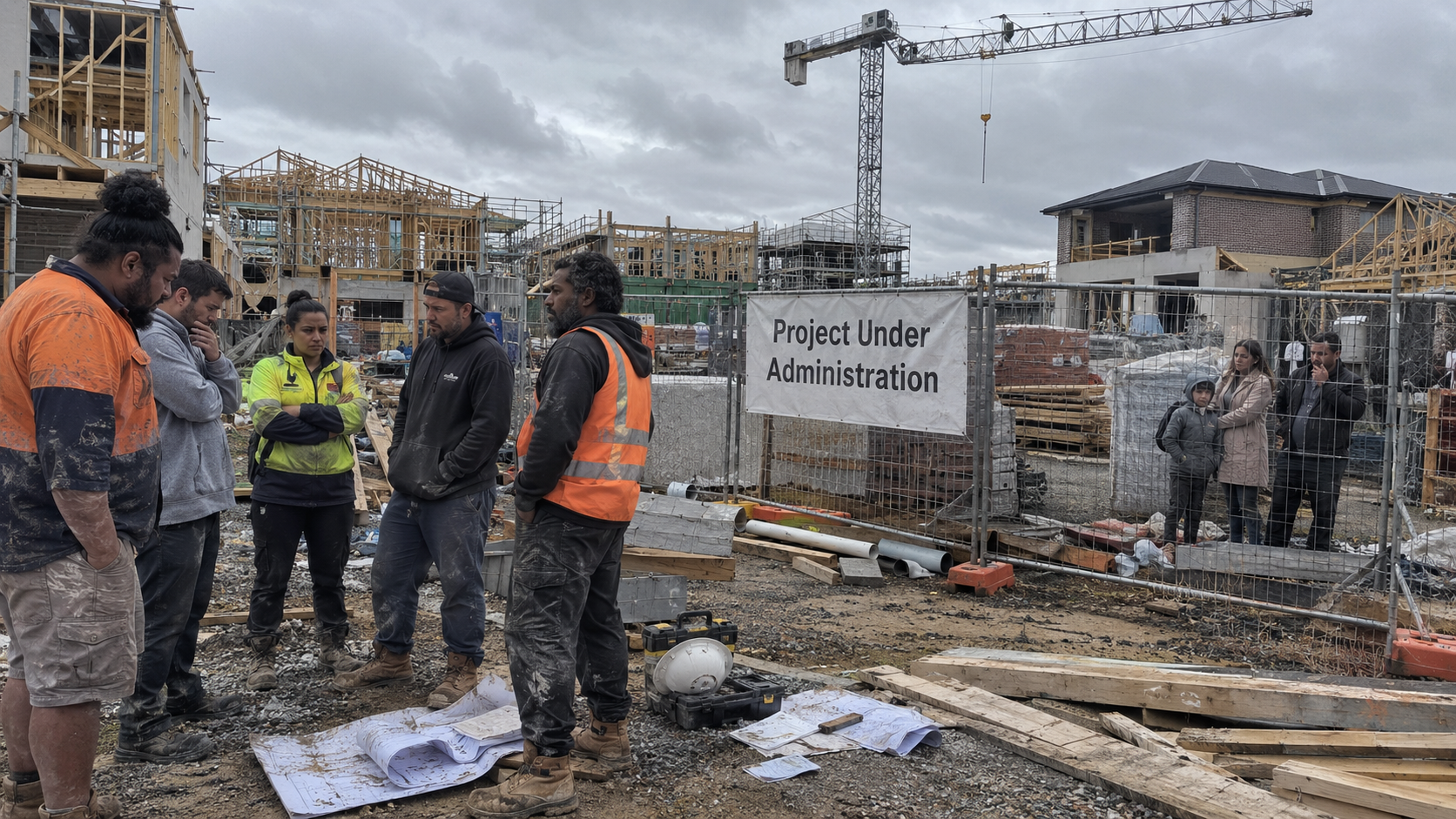
When a property developer collapses, the construction site doesn't simply disappear.
There may be lenders with millions already committed, buyers waiting for homes, tradies owed money, employees waiting for wages and half-finished projects that could lose even more value if work stops.
So who takes control? And what happens next?
On the Teach Me About Property Podcast, Massey Archibald and Felise unpacked a major developer administration unfolding in Australia — and used it to explain what really happens when a large property development business runs out of road.
The Short Version
When a property developer enters voluntary administration, control can shift away from its directors while administrators assess the company's financial position and options.
From there, outcomes can differ from project to project.
Secured lenders may enforce rights over particular assets or projects. Some developments may continue. Others may stop. Receivers can be appointed. Completed stock may be sold. Buyers, employees, contractors and unsecured creditors can all face different risks.
And sometimes, finishing a development can make more financial sense to a lender than abandoning it.
That's where this story gets interesting.
What Does It Mean When a Property Developer Goes Into Voluntary Administration?
Voluntary administration is a formal insolvency process.
It generally means a company is in serious financial difficulty and an independent administrator is appointed to investigate its affairs and assess available options.
For people watching from outside, the headline can sound simple:
Developer collapses.
But the reality underneath it can be incredibly complicated.
A large developer might have dozens — or even hundreds — of separate projects.
Different projects can have different lenders.
Some sites may only be land.
Some may have planning approval.
Some may be halfway through construction.
Others could be practically finished.
Some properties may already be under contract.
So even when they all sit under one development group, they don't necessarily have the same risk or the same outcome.
That's one of the key ideas Massey explains during the podcast.
What Happened in the Developer Case TMAP Discussed?
The numbers discussed by Massey were substantial.
He told Felise the developer had 219 development sites and that administrators had attributed approximately $4.9 billion in paper value to those assets.
But here's the problem.
Massey said only around $400 million of property was considered sale-ready or under contract.
That's a crucial distinction.
A development site may theoretically be worth a lot of money.
That doesn't mean the developer has that money sitting in a bank account.
As Massey explains:
“Only about 400 million of actual property was sale ready or under contract.”
A developer can therefore appear enormously wealthy on paper while experiencing a very real cash-flow crisis.
How Can a Developer With Billions in Assets Run Out of Money?
Because asset value and available cash aren't the same thing.
Imagine a developer owns a site expected to be worth $50 million when the project is finished.
That sounds impressive.
But construction still needs to happen.
Employees need to be paid now.
Contractors need to be paid now.
Interest may need to be paid now.
Taxes may be due now.
Materials need to be purchased now.
The $50 million future value doesn't necessarily pay Friday's payroll.
This is one of the fundamental risks of development.
A developer can have valuable assets and still experience a liquidity problem if enough cash isn't available at the right time.
And once construction slows or stops, the problem can become even harder.
Why Do Lenders Matter So Much When a Developer Collapses?
Because property development is capital intensive.
Large projects are rarely funded entirely from the developer's own cash.
Money can come from banks, non-bank lenders, private credit funds, investors and other financing arrangements.
Those lenders don't necessarily lend to the entire business in exactly the same way.
Some financing may be secured against specific property or development assets.
That's why the podcast discussion becomes particularly interesting.
Massey says there were around 40 lenders connected with the developer being discussed.
Felise initially imagines them all trying to rescue the company together.
But Massey explains that isn't necessarily what happens.
Individual lenders may focus on protecting the particular projects against which they've lent money.
His explanation is essentially:
This is our project. We have money in it. We need to work out how to recover that money.
Can a Lender Take Over a Property Development?
Depending on the loan documents, security arrangements, insolvency process and circumstances, a secured lender may have enforcement rights when a borrower defaults or enters administration.
That can potentially involve appointing receivers over secured assets.
Massey explains the practical side to Felise:
“When you go into administration, you're not the ultimate decision maker anymore.”
That doesn't necessarily mean the lender becomes a property developer forever.
The objective is generally much more straightforward:
Protect and recover capital.
Sometimes that means selling an asset.
Sometimes it can mean allowing a project to proceed further.
The best decision depends heavily on how far the development has progressed.
Why Would a Lender Keep Building Instead of Selling Immediately?
Because an unfinished development can be much harder to sell.
Imagine two projects.
Project A: 65 completed townhouses.
Project B: 65 townhouses that are 40% constructed.
Which is easier to sell?
Usually the finished one.
Buyers can inspect it.
Settlement can potentially occur sooner.
There's less construction uncertainty.
The lender may have a clearer path toward recovering money.
That's why Massey points out that some of the safest projects in a developer collapse can potentially be those closest to completion.
“The safest people are on the projects that are... near completion.”
That's not a guarantee for buyers.
But economically, the logic makes sense.
If relatively little work remains and completing that work substantially improves the value or saleability of the asset, stakeholders may have a strong incentive to get it across the line.
What Happens to the Tradies Working on the Project?
This is where a corporate collapse stops being a financial headline and becomes personal.
Builders.
Electricians.
Plumbers.
Carpenters.
Engineers.
Suppliers.
Subcontractors.
Employees.
There can be a long chain of people relying on the developer getting paid and continuing to operate.
In the case discussed on the podcast, Massey says millions were outstanding in employee wages and superannuation.
His reaction is immediate:
“That's the most disappointing — wages and super.”
Because behind the billions in development values are ordinary households waiting for their pay.
Some contractors may also have outstanding invoices for work already completed.
And whether those amounts are recovered can depend on contractual arrangements, security, insolvency priority rules and what assets ultimately remain available.
Could a Lender Pay Contractors Directly to Finish a Project?
Potentially, depending on the structure put in place.
That's one of the scenarios Massey discusses.
If a lender decides that finishing a project offers the best chance of recovering its capital, arrangements may be made to fund continued work.
Massey explains it in practical terms:
“We'll pay you from now on.”
The underlying logic is simple.
If you've already funded most of a development and only a relatively small amount remains before completion, walking away can destroy value.
Putting additional money in can sometimes protect the much larger amount already exposed.
But every project is different.
The numbers still have to work.
Why Doesn't Another Builder Simply Finish the Development?
Because taking over someone else's half-completed construction project can carry significant risk.
Massey puts it well:
“You don't know where the skeletons are in the closet.”
A replacement builder needs to understand what's already been done.
Was it built correctly?
Does completed work comply with plans?
Are there defects?
What documentation exists?
Which subcontractors were used?
What warranties apply?
What still needs to be completed?
Who becomes responsible for existing problems?
That's why finding a replacement builder can be far more complicated than simply calling another construction company and asking them to finish the job.
A nearly completed project with an existing construction team can therefore look very different from a development where work has barely started.
What Happens to People Who Bought Off the Plan?
This is where buyers need to be particularly careful.
There is no single outcome that applies to every off-the-plan buyer when a developer enters administration.
It can depend on factors including:
- the buyer's contract;
- the project's construction stage;
- whether the development continues;
- finance and security arrangements;
- deposit protections;
- sunset and termination provisions;
- whether a receiver is appointed; and
- decisions made through the administration process.
A buyer in a development that's practically complete may face a very different situation from somebody whose apartment hasn't started construction.
That's why buyers affected by an actual developer insolvency should obtain advice specific to their contract rather than relying on general commentary online.
Why Does the Stage of Construction Matter So Much?
Because the closer a project is to generating cash, the easier the economic decision can become.
Consider this simplified example:
| Project stage | Potential issue |
|---|---|
| Vacant development land | Significant capital still required |
| Planning/approval stage | Long path before revenue |
| Early construction | High remaining construction risk |
| Near completion | Smaller gap to finished value |
| Fully completed stock | Can potentially be marketed and sold |
This isn't a ranking of which project is legally safest.
There can be complications at every stage.
But it demonstrates why lenders may treat projects differently.
A development group can collapse while some individual projects continue relatively normally and others don't.
Why Would Lenders Break Up the Developer's Portfolio?
Because waiting for one giant rescue might not produce the best outcome.
Massey says there had been an attempted large refinancing deal for the developer discussed on the podcast.
According to his account, the proposed deal ultimately fell over.
That leaves another option:
Instead of rescuing the entire group, lenders deal with individual projects.
Massey describes lenders beginning to take control of separate assets rather than waiting for one solution to fix everything.
That's important.
When people hear:
“Developer has 219 sites.”
it sounds like one giant problem.
In reality, it may become 219 smaller problems with different economics, lenders, buyers and potential outcomes.
Could a Developer Collapse Push Property Prices Down?
Potentially — particularly in a concentrated local market.
This is one of the more interesting risks Massey raises.
He says many of the developer's projects were concentrated around northwest Sydney, including areas such as Schofields, Marsden Park, Riverstone, Box Hill and surrounding locations.
Then he identifies the danger:
“The big risk is that all of these lenders get spooked and they try to dump all the stock at the same time.”
Why would that matter?
Supply.
Imagine 10 lenders each have 30 properties they want to sell.
If they release those properties gradually, buyers may absorb the stock.
If everybody wants out immediately, 300 properties could hit the market around the same time.
Suddenly sellers are competing against each other.
Buyers have more choice.
Price becomes more important.
Discounting can increase.
That's how distress associated with one developer could potentially affect a very specific local market without causing an Australia-wide property crash.
Could This Create Opportunities for Property Buyers?
Potentially.
But “distressed” doesn't automatically mean “bargain.”
That's an important distinction.
Massey points out that lenders generally want to recover the money they're owed.
They're not necessarily trying to give property away.
If a lender is owed $800,000 against an asset that might normally sell for $950,000, there may be room for a buyer to negotiate.
But if the lender is owed almost the full market value, the potential discount may be much smaller.
There can also be additional risks.
Incomplete construction.
Defects.
Contract complications.
Limited warranties.
Strata issues.
Uncertain completion dates.
Different sale conditions.
The discount needs to compensate for the risk you're actually taking.
A cheap problem can still be an expensive mistake.
What Can Property Investors Learn From a Developer Collapse?
Probably more than just “look for discounted stock.”
The bigger lesson is about understanding who carries risk.
When a development is booming, everything can look easy.
Land values rise.
Sales occur.
Finance is available.
Construction continues.
Everyone gets paid.
But when conditions tighten, the structure underneath the deal becomes visible.
Who funded the project?
How much debt is there?
What security does the lender hold?
How much construction remains?
Have presales settled?
What happens if valuations fall?
Can the developer access more capital?
Can the project survive a delay?
Those questions aren't exciting during a boom.
They become extremely important when something goes wrong.
What Should Buyers Check Before Buying From a Developer?
You can't eliminate development risk entirely.
But you can investigate it.
Before committing to an off-the-plan or newly developed property, questions worth exploring include:
Who is the developer?
Look at their history and completed projects.
Who is the builder?
Developer and builder aren't necessarily the same company.
How far has construction progressed?
Buying completed stock is different from buying something that exists only on plans.
What does your contract actually say?
Don't assume. Get appropriate independent legal advice.
How is your deposit handled?
Understand where the money sits and the contractual conditions surrounding it.
What happens if completion is delayed?
Know the relevant clauses.
What is happening with comparable supply nearby?
A large volume of similar stock can affect both resale and rental conditions.
And most importantly:
Don't let a discount stop you doing due diligence.
The bigger the apparent bargain, the more important it can be to understand why the bargain exists.
A Developer Collapse Isn't One Story
That's probably the biggest takeaway from Massey's explanation.
The headline might say:
PROPERTY DEVELOPER COLLAPSES
But underneath that headline could be hundreds of different stories.
One completed project gets sold.
Another continues construction.
A lender appoints receivers.
Another lender waits.
A buyer settles normally.
Another buyer faces months of uncertainty.
A contractor gets retained.
Another is owed money.
A parcel of land is sold.
A nearly finished development gets funded through completion.
That's why it's dangerous to make assumptions from the headline alone.
You need to know where your project sits inside the wider collapse.
Follow the Money
When a property developer gets into serious financial trouble, emotion can make the situation difficult to understand.
Follow the money instead.
Who is owed what?
Who holds security?
Which projects are finished?
Which projects can generate cash soon?
How much additional money is required to finish construction?
Who has the legal ability to take control?
What outcome gives creditors the best chance of recovering their money?
Those questions often explain why one project keeps moving while another stops.
And they're the questions Massey and Felise begin unpacking in this episode.
Because a developer collapse isn't simply about a company running out of money.
It's about what happens next to the properties, people and billions of dollars already caught inside the machine.
Listen to the Full Conversation
Massey Archibald and Felise break down the developer administration, private lenders, receivers, unfinished projects and potential impact on northwest Sydney property markets on the Teach Me About Property Podcast.
The episode also explores the wider Australian property market, distressed sales, Brisbane and Melbourne units, and how buyers can think about opportunity when markets become uncertain.
Listen to the Teach Me About Property Podcast on YouTube →
Frequently Asked Questions
What happens when a property developer goes into voluntary administration?
An independent administrator takes control of the company and investigates its financial position and available options. Individual developments may have different outcomes depending on their financing, construction stage, contracts and secured creditors. Some projects may continue while others may be sold, paused or become subject to enforcement action.
Can a lender take over an unfinished property development?
A secured lender may have enforcement rights when the borrower defaults, depending on its security documents and the circumstances. This can include appointing a receiver over secured assets. Whether construction continues depends on the project's economics, financing arrangements, remaining work and decisions made by the relevant parties.
What happens to off-the-plan buyers if a developer collapses?
The outcome depends on the buyer's contract, construction stage, deposit arrangements and what happens to the development through the insolvency process. A developer entering administration doesn't automatically mean every contract ends or every buyer loses their deposit. Affected buyers should obtain independent legal advice about their specific contract.
Can a developer collapse cause local property prices to fall?
It can potentially put pressure on a local market if a large amount of similar stock is released for sale over a short period. The impact depends on the volume, location, buyer demand and how lenders or receivers sell the assets. One developer's collapse does not automatically cause a broader property market crash.
Are mortgagee or receiver sales always property bargains?
No. A forced or receiver-controlled sale doesn't guarantee a property will sell below fair value. Creditors generally seek to recover as much as reasonably possible. Buyers also need to consider property condition, incomplete works, contracts, defects, warranties and other risks before treating a distressed property as an opportunity.
About Teach Me About Property
Teach Me About Property (TMAP) helps everyday Australians understand property, finance and long-term wealth creation.
Through education, mentorship and the Teach Me About Property Podcast, Massey Archibald and Felise go beyond property headlines to explain the structures underneath them — from market cycles and finance to developers, lenders and the risks buyers need to understand.
Because knowing that something happened isn't enough.
Understanding why it happened is where the real education begins.
General Information & Legal Disclaimer
This article provides general educational information only and does not constitute financial, investment, credit, insolvency or legal advice.
Insolvency, receivership, property development and off-the-plan contracts involve complex legal and financial arrangements. Outcomes depend on the specific company, financing structure, security interests, contracts, jurisdiction and circumstances. Anyone directly affected by a developer insolvency should obtain independent professional advice relevant to their situation.
Figures, events and opinions attributed to Massey Archibald and Felise reflect information discussed during the relevant Teach Me About Property Podcast episode and should not be treated as independently verified current facts unless separately sourced.